|
The team | View unanswered posts | View active topics
|
It is currently Mon Nov 20, 2023 6:28 am
|
|
Board index » Plant and garden discussion » On the Edge
All times are UTC
|
|
Print view
|
Previous topic | Next topic |
Yucca lacandonica: A unique rainforest epiphyte
| Author |
Message |
|
Stone Jaguar
Joined: Tue Oct 06, 2009 5:12 pm
Posts: 147
Location: Guatemala City, Guatemala 1600 m.a.s.l.

|
 Yucca lacandonica: A unique rainforest epiphyte
Greetings:
First post on this website...I actually wrote this piece for another tropical plant forum some months back, but the topic did not gain any traction due to a lack of succulent enthusiats there. Hopefully, there is more interest in this plant here!
In the minds of most gardeners the woody lilies (Agavaceae) evoke images of the harsh but scenic landscapes of the American Southwest and northern México. Abundant, drought tolerant and attractive, these plants are signature components of urban xeriscaping in the U.S. desert states. There are significant collections of ornamental Agave spp., Furcraea spp., Dasilyrion spp. and Yucca spp. in both public and private gardens worldwide, and these plants certainly have many fans even in northern Europe. Several species are grown on a huge scale throughout the dry tropics and subtropics for food (flowers and occasionally roasted stems), fiber (sisal and henequen) and drink (pulque, mescal and tequila). Given the considerable tolerance of some desirable species to both wet and freezing conditions, they are widely available at garden centers and mail order nurseries around the world.
While members of the genera mentioned above do occur sporadically in wet forests in southern México, northern Central America and northeastern South America, when occupying more mesic habitats they tend to be restricted to either exposed rock outcrops/landslips, cliffs, mixed forest-grassland or forest edge. As one moves upwards into cloud forests, they tend to be more abundant in lower montane ecosystems, but usually prefer sunny, exposed locations and well-drained soils.
Many ostensibly terrestrial plant families are known to exploit epiphytic niches on an opportunistic/fortuitous basis throughout the tropics. Thus, it is no surprise to botanists familiar with moist upland habitats in the northern Neotropics to encounter such surprises as large barrel cacti and mammillarias (Ferocactus spp., Mammillaria spp.), echeverias and related genera (Echeveria spp. and Graptopetalum spp)., small palms (Chamaedorea spp.and Geonoma spp.), “baby” cycads (Zamia spp. and Dioon spp.) and even fully-developed ponytails (Beaucarnea spp.) happily esconced in the crotches of massive old oaks and other large native trees.
While several lithophytic Agave spp. may also adopt an epiphytic lifestyle when fate dictates seed dispersal into suitable trees and the opportunity otherwise arises, my view is that this occurrence is little-known and under-reported in popular reference works. Howard Gentry in his classic and exhaustive regional monograph on this genus, “The Agaves of Continental North America” (1982) makes only a single brief reference to it under his treatment of Agave polyacantha in eastern México. Irish & Irish in their recent handbook, “Agaves, Yuccas and Related Plants: A Gardener’s Guide” (2000) make no mention of these plants occurring as epiphytes. While not exactly a common encounter, over the course of the past decades I have found several very large spp. of agaves growing in oaks in Oaxaca (including some giant individuals in forests on Cerro Baul and in the Sierra Mixe), Chiapas (above Pijijiapan), Guatemala (in both Huehuetenango and Alta Verapaz) and El Salvador (on Volcán Montecristo). Perhaps coincidentally, all of these observation have been made in seasonally dry pine-oak or pine-oak-sweetgum (Liquidambar styraciflua) forests between 1,400 and 1,600 m elevation (4,550 – 5,200’) with bright southeastern exposures. At sites I have visited where agaves do grow on tree limbs there are invariably more than just a couple of individuals exhibiting this trait.

This photo was taken in June of last year, and shows an approximately one meter diameter (3’) Agave hiemiflora growing on the branch of an oak in cloud forest San Cristobál Verapaz, Guatemala. Note the colonial peperomias and orchids growing alongside it on the tree. This species, together with A. seemaniana, is common/abundant in its normal guise as a lithophyte in this region where it also occurs on exposed rocky slopes with several noteworthy aroids and orchids.
Yucca lacandonica is, at this juncture, the only member of the Agavaceae known to have foregone a terrestrial lifestyle and taken to the air in a definitive way. Yucca lacandonica may also be one of a very few members of the family to be an inhabitant of closed canopy tropical wet forests – although the endemic Agave lagunae may also stray into these ecosystems on occasion - and its survival is almost certainly linked to conservation of these ecosystems in this region. The plant was described by Mexican botanists Arturo Gómez-Pompa and Javier Valdés in 1962 and remains very rare in collections to this day. Its specific title refers to the Lacandón Maya who inhabit the once remote tropical wet forests of eastern Chiapas (this is also the same general locality where the Zapatista rebellion broke out in 1994). While originally believed to be a Mexican narrow endemic, it is now known to occur spottily across a wide swath of the lowland wet tropics of southestern México (the states of Oaxaca, Veracruz, Tabasco and Chiapas), north-central Guatemala (departments of Alta Verapaz and El Petén) and extreme southern Belize (Toledo District). The Mexican government has listed its status as “Threatened”. Ironically, the first known herbarium collections made of this plant was made in 1935 by Australian botanist-adventurer William Schipp in Belize, not México.

Its closest relative is the native Yucca elephantipes (syn. Y. guatemalensis) with which it shares a number of vegetative characteristics. This ubiquitous species, locally known as izote, is widely utilized throughout Guatemala and El Salvador (where it is the national flower) to control erosion and to mark property boundaries. Like several other Yucca spp., its flowers are esteemed as food items by local peoples, and the panicles are often seen for sale in regional markets during the late spring. Yucca elephantipes also occurs as a naturalized terrestrial species at two forested localities where I have also observed Y. lacandonica as an epiphyte. Key characters that differentiate the two taxa when sterile include much longer leaves in Y. lacandonica (to >1.80 m/ca.6’ vs. usually <1.20 m in Y. elephantipes) that are very glossy on their upper surfaces (Y. elephantipes has matte or subglossy leaves, often with a granular/mildly abrasive feel to them) with a 0.5-1.0 mm (1/50”-1/25”) wide bright yellow margin. The leaf margins are also far more minutely serrate than the margins of leaves on T. elephantipes, and the teeth require magnification to discern clearly, while those of its sib species are usually visible to the naked eye. Leaf scars, petiole bases and stem development are also quite distinct between the two species upon close examination. While both can become sizeable pachycaul trees with time, the caudexes of Y. lacandonica are distinctly massive/subglobular even in young examples.

Although the documented presence of disjunct populations of Yucca lacandonica in both eastern Chiapas, México and the southern Maya Mountains of Belize pointed to the probable presence of this plant in Guatemala, it was only until April of 2004 that, together with local botanist Juan José Castillo Mont, we were able to confirm its occurrence in this country with a series of color photographs, live collections and herbarium vouchers (AGUAT).

Since this report remains unpublished and its presence here has not been widely-disseminated, a recent annotated checklist of Guatemalan Agavaceae by Mexican succulent plant researcher Abisaí García-Mendoza (in: “Biodiversidad de Guatemala Vol 1”, 2006) did not include Y. lacandonica.
While all previous reports and photographs indicate that this species is an obligate epiphyte, at one lightly-disturbed locality we were also able to collect several plants growing as medium-sized erect terrestrial trees on karst soils, as gnarled lithophytes on very steep limestone cliffs, and as enormous spreading epiphytes in canopy trees. Certainly, they are usually observed as epiphytes throughout their known range. The colony illustrated below was growing from the upper canopy of an immense emergent amapola/shaving brush tree (Pseudobombax ellipticum), certainly in excess of 25 m (>80’) tall and greater than 4 m (13’) diameter at breast height. This type and size emergent Malvaceae/Bombacaceae is what I jokingly refer to as free-standing ecosystems. Due to serious difficulties in getting above the canopy of this tree, we were unable to determine the size of the individual yucca depicted in the photographs, but its overall spread was certainly in excess of 9 m (30’). Unfortunately, I understand that this site was destroyed two years ago during the construction of a new paved highway across the northern slopes of the Sierra de Chamá.

On its home turf in lowland wet forests, this species flowers at the end of the dry season (April/early May), which is replicated in culture in the highlands of Guatemala City. While the identity of its pollinator remains elusive, all other Yucca spp. are known to have a mutualistic relationship with prodoxid moths, which are both pollinators as adults and seed predators as larva. In these images note how the inflorescence of stems flowering in the canopy stand well free of the surrounding foliage. Flowers are waxy, fairly long-lasting and of considerable substance. During the course of hand-pollinating flowers in the early evening and predawn for more than two weeks, I have detected a mild scent of mint in open flowers that fades as the morning progresses. While probably pollinated by an insect/s, it is also entirely possible that nectivorous bats may occasionally play some secondary role in pollinating Y. lacandonica.


Yucca lacandonica is, predictably, of easy culture and extremely tolerant of drought conditions and abuse from occasionally careless/clumsy gardeners (=me). While I have long envisioned planting one in a huge teak basket and hanging it from the old cypress in my back garden, space limitations and practicality dictate that I grow them on the ground in oversize terracotta pots containing very free-draining media composed of five parts pumice, 4 parts sifted oak leaf litter and 1 part hort. charcoal pieces. They require frequent feedings to keep them from looking chlorotic/ratty. Brief experience with them in captivity (five years) indicates that they are fairly fast-growing, regenerate well from both succulent offsets and woody stem cuts, and are frost-tolerant and relatively pest-free. Large specimens would undoubtedly look amazing established as epiphytes on giant park trees like raintrees (Albizia saman, silk-cottons (Bombax spp.; Ceiba spp.) and so forth.
I understand that the Missouri Botanical Gardens was the first public collection to flower this species (in 2001 in the Climatron) from material collected in 1997 at the Bladen Nature Reserve in southern Belize. For a variety of reasons, I suspect that the Huntington BG and the New York BG may also grow this rare and unique yucca. Given its focus on epiphytes, Selby BG would also be a good bet as having them in their collection. Beyond these, I have not been able to find any reference to this plant being grown outside of a handful of private collections in Guatemala and México. They certainly deserve a wider audience amongst tropical fat plant growers.
Ciao,
JPV
_________________
"He prayeth well, who loveth well
Both man and bird and beast."
|
| Thu Oct 08, 2009 4:47 pm |

|
|
|
David Matzdorf
Site Admin
Joined: Mon Oct 29, 2007 4:06 pm
Posts: 5327
Location: Islington, London UK
|
Welcome, JPV. You'll certainly find some succulent, Agave and Yucca enthusiasts here, myself included.
Very interesting article that soon had me trying to work out where in my urban garden I could fit a piece of Y. lacandonica.
Incidentally, if you want to know if the NYBG is growing Y. lacandonica, I could ask my cousin, who works as a botanist there.
_________________
51º33'07"N x 0º07'21"W
43m (142 feet) ASL
|
| Thu Oct 08, 2009 6:51 pm |
|
|
|
Paul Spracklin
Joined: Tue May 05, 2009 3:55 pm
Posts: 2564
Location: North Thames delta UK
|
Hi JPV
What a great post! Those are the best series of pictures I have seen of this plant for sure. It also adds something to a puzzle concerning a yucca I saw when travelling through Oaxaca, north up hwy 175. Maybe you can shed some light on this one?
First some pictures.
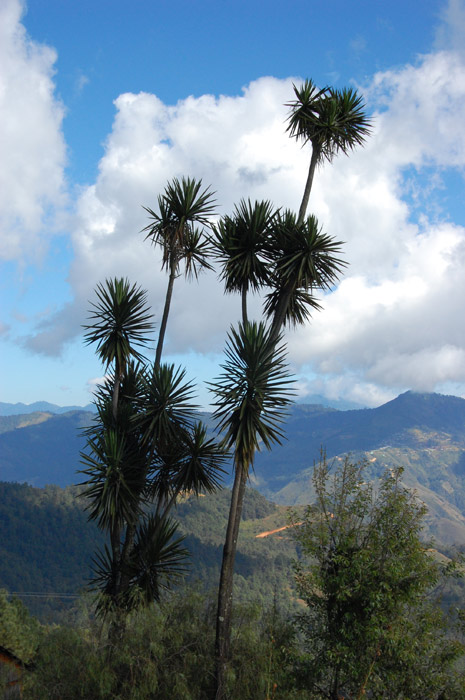
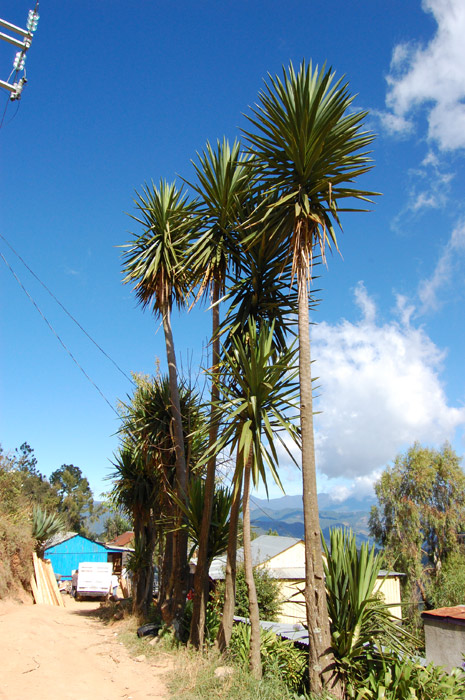
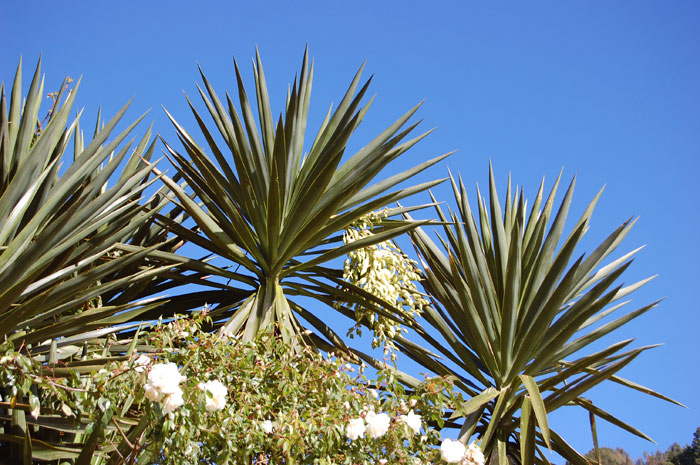
I saw this being cultivated along boundaries here and there from lowland tropics near to Pochutla right up into the mountains at 2600m or so, along where Agave atrovirens is found. No wild specimens, just cultivated plants. It was used often alongside Yucca elephantipes, so I know it isn't that - but what could it be? It was suggested it might be Yucca lacandonica but I now don't think so.
_________________
visit my website - www.oasisdesigns.co.uk
|
| Thu Oct 08, 2009 7:03 pm |
|
|
|
Stone Jaguar
Joined: Tue Oct 06, 2009 5:12 pm
Posts: 147
Location: Guatemala City, Guatemala 1600 m.a.s.l.
|
Paul and David:
Thanks for the kind words.
While Y. lacandonica does attain impressive dimensions, it usually is decumbent once past a meter and a half or so tall and octopus-like when well-established. Older plants have a rather massive, bulbous caudex and a distinctively tattoo'ed bark, not to mention very lax leaves when grown in canopy shade. Not sure what the yucca in Paul's pics is, but leaf characteristics, infl. architecture, etc. in Y. cf. elephantipes are extremely variable even here. Based on the amount of morphological variation evident in hedgerow yuccas in Guatemala, El Salvador and in southern México, I suspect that there may be more than one taxon involved...perhaps this is best viewed as a sort of "feral syngameon", with all the evident variation in form that would entail. Alternately, and as is suspected in some Furcraea and Agave spp. (such as tecta), these plants may have been transplanted in Precolombian times from the Mexican plateau to northern Central America for food and/or fiber...several such translocations from different areas, with subsequent hybridization>further introgression taking place here might explain why there is so much variability in these arborescent yuccas. And to confuse matters for future botanists even further, there are quite a few variegated "elephantipes" in hort. and semi-naturalized here that appear to be fairly recent gloriosa imports!
Cheers,
Jay
_________________
"He prayeth well, who loveth well
Both man and bird and beast."
|
| Thu Oct 08, 2009 8:44 pm |
|
|
|
david feix
Joined: Wed Oct 31, 2007 3:54 am
Posts: 3176
Location: Berkeley, California
|
Jay,
Nice to see you posting here as well as on the other web site, which doesn't seem to get much traffic these days now that Greg the web site owner no longer posts. Hope to see more of your always informative posts here on GOTE in the future. I must admit there isn't a whole lot of overlap between what you can grow in your climate and mine here in the San Francisco Bay Area, but it remains interesting none the less. It never ceases to amaze me that Agaves in general seem to have more ardent fans in Britain that they do here in California, where they are certainly common enough, but seldom generate the intense enthusiasm across the board,(outside succulent and cactus grower circles), that they do elsewhere.
I wonder if you could give us a little background on your nursery/plant interests, and how long you have been growing plants where you are?
David in Berkeley, California, on another beautiful fall day
|
| Thu Oct 08, 2009 9:11 pm |
|
|
|
Kev Spence
Site Admin
Joined: Mon Oct 29, 2007 3:59 pm
Posts: 10865
Location: Loughborough, Leics, central UK
|
Hi Jay,
Nice first post love those sumptuous photos you have posted and that Agave hiemiflora growing in the cloud forest is something to behold.
We were lucky enough to visit the cloud forest of Costa Rica last year and that is one thing we did not see growing epiphytically in the canopy though every living fern imaginable seemed to be there.
The cloud forest pictured in your shot seems very much more open than we experienced at Monteverde perhaps the reason why this Agave is flourishing.
Thanks for bringing to my attention another rare and unusual growing plant...... the plant world never ceases to amaze at what is still out there to be found.
Hope you get a little more feedback on this forum as any future posting by yourself will be much appreciated.
The Monteverde threads are still archived on this site should you wish to check them out just search said name.
|
| Thu Oct 08, 2009 9:12 pm |
|
|
|
virtualpalm
Joined: Sun Jun 21, 2009 1:55 pm
Posts: 56
Location: Miami, FL USA
|
Hey Jay. Great photos and excellent account (I would expect nothing less!). Thanks for posting it here.
I'd love to try it here in Miami if there is ever a source here in the States.
Jody
|
| Thu Oct 08, 2009 9:46 pm |
|
|
|
Stone Jaguar
Joined: Tue Oct 06, 2009 5:12 pm
Posts: 147
Location: Guatemala City, Guatemala 1600 m.a.s.l.
|
LOL! "We are not alone" - thank God!
Glad to see some Gringos from TS and the IPS/cycad forums here.
I found this site last week quite by accident while looking for information on Agave chazaroi. Nick Macer's photographic safari of trekking the agave trail in northern and central México is one of the most beautifully illustrated - and informative - accounts of the the search for newly-described plants that I have seen of late. Kudos for him are clearly in order. I have not had a chance to go over the site carefully (will certainly check out the Monteverde posting since I used to own a cardamom plantation up in Arenal), but am heartened to find an articulate and well-informed group of growers on the web. Frankly, I had despaired on ever finding a good generalist "tropicals" forum on which to post.
David...while collector agaves may not have a huge following in California, they certainly do in both Tucson and Scottsdale, Arizona. I assembled most of my original agave collection (now, sadly, quite diminished due to competition for space from Madagascan fat plants) from nurseries in Phoenix-Scottsdale in the late 90s and, believe me, they had crazy nice stuff even then.
I tend to specialize in the propagation and cultivation of challenging and obscure cool climate (=cloud forest) and xerophytic tropicals, rare dwarf palms and the odd spectacular native plant. I also work with a couple of groups that are not well-represented in hort., such as Malesian ant-rubiacs, rheophytic cyclanths and showy Neotropical ericads. I breed a few orchids, a few more adeniums, a lot of anthuriums, and even more bromes (landscape foliage-type). Will try and get some other posts up to give you an idea of what it is I actually work with, but I will obnoxiously put out the tease out that it is now in excess of 1400 spp. and 100+ hybrids.
Jody...need to chop up a few of mine, sprout them and get them up to Enid Offolter next year. Will advise when I get off my duff and actually make this happen.
Cheerio,
Jay
_________________
"He prayeth well, who loveth well
Both man and bird and beast."
|
| Thu Oct 08, 2009 10:13 pm |
|
|
|
Charles Wychgel
Joined: Fri Nov 02, 2007 10:09 pm
Posts: 757
Location: Algarve/Portugal
|
Fantastic first post Jay
I have read your contributions to the IPS forum, very pleased you are posting here as well, thanks 
_________________
37º 04' 16 71" N
8º 50' 13 59" W
|
| Fri Oct 09, 2009 5:08 am |
|
|
|
Michael (SW Ireland)
Joined: Tue Oct 30, 2007 12:38 pm
Posts: 1912
Location: Cape Clear Island, Roaringwater Bay
|
Hi Jay, thanks for your absolutely fascinating article. I would love to see some photos of Ferocactus and Mammillaria growing epiphytically! Your photo of Agave hiemiflora is quite mind-boggling.
There are quite a few succulents from cloudforest altitudes in southern Mexico and northern Central America that have proven amenable to cultivation in the milder parts of Britain and Ireland, so you will have a ready audience here. I would love to know if you have any pics or info on Furcraea quichensis, since there is very little about this species on the web. I have a couple of plants I grew from seed offered by Rare Palm Seeds a few years ago, which I'm hoping are the real thing. Here they are:

|
| Fri Oct 09, 2009 11:18 am |

|
|
|
wahaj
Joined: Mon Nov 05, 2007 11:41 am
Posts: 116
Location: Leicester, UK
|
Brilliant photos, thanks very much for sharing them.
Have you any photos and information on other epiphytes in the area?
Looks like a very unique forest.
|
| Fri Oct 09, 2009 11:36 am |
|
|
|
virtualpalm
Joined: Sun Jun 21, 2009 1:55 pm
Posts: 56
Location: Miami, FL USA
|
Michael (SW Ireland) wrote:
I would love to see some photos of Ferocactus and Mammillaria growing epiphytically!
Michael, here is Mammillaria dixanthocentron growing on the trunk of Dioon califanoi in Oaxaca, Mexico:

Enjoy!
Jody
|
| Fri Oct 09, 2009 2:01 pm |
|
|
|
Michael (SW Ireland)
Joined: Tue Oct 30, 2007 12:38 pm
Posts: 1912
Location: Cape Clear Island, Roaringwater Bay
|
Hi Jody, what an amazing and bizarre sight! This thread is becoming a real eye-opener. Any chance you could make the photo a bit bigger, there is a lot going on there.
|
| Fri Oct 09, 2009 2:23 pm |
|
|
|
Paul Spracklin
Joined: Tue May 05, 2009 3:55 pm
Posts: 2564
Location: North Thames delta UK
|
This pic is not very clear but here is Agave titanota growing epiphytically on the trunk of Beaucarnea gracilis:
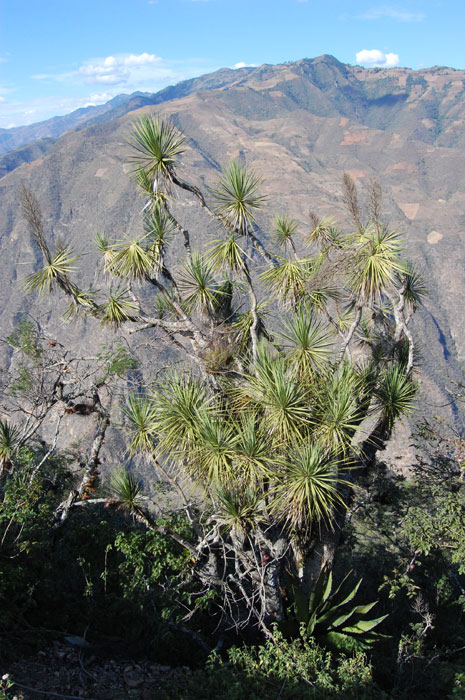
The agave is a good couple of feet up the trunk - there is considerable foreshortening because the beaucarnea is some way down a steep incline from the road edge, which is where I was standing (and quaking! I hate looking over steep edges...)
_________________
visit my website - www.oasisdesigns.co.uk
|
| Fri Oct 09, 2009 2:49 pm |
|
|
|
jam
Joined: Tue Oct 30, 2007 9:31 am
Posts: 320
Location: Nitra, SW Slovakia, Central Europe N48° 19'12.42" E18°06'50.15"
|
Jay, nice to see you here. I've always enjoyed your input on Geonoma, Chamaedorea, etc. species on the IPS board.
Cheers, jam
_________________
Cheers, Jan
--------------
:: growing well beyond the edge ::
|
| Fri Oct 09, 2009 3:03 pm |
|
|
|
|
Board index » Plant and garden discussion » On the Edge
All times are UTC
|
Who is online |
Users browsing this forum: david feix and 13 guests |
|
You cannot post new topics in this forum
You cannot reply to topics in this forum
You cannot edit your posts in this forum
You cannot delete your posts in this forum
|
|